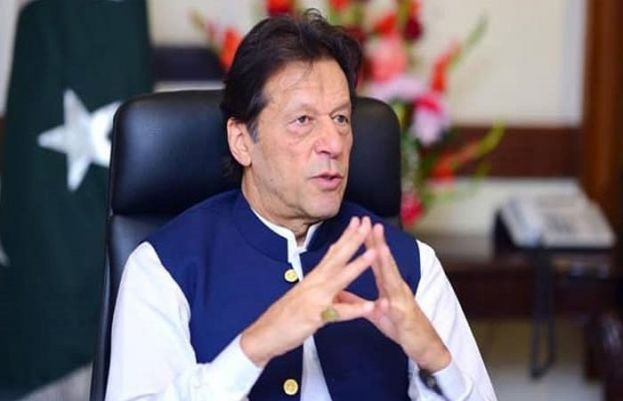
PM Imran Khan rejects Sindh govt's 'complete lockdown' suggestion

PM Imran Khan
Prime Minister Imran Khan on Wednesday rejected the Sindh government's recommendation to impose a "complete lockdown" across the country for two weeks.

Sindh Chief Minister Murad Ali Shah had earlier said the government should impose a "complete lockdown" across the country for two weeks to stem the spread of the virus.

Reacting to his comments, the prime minister said Pakistan cannot afford a complete lockdown, adding that the measure would adversely impact daily wage earners across the country.

He said, for the time being, the government will impose smart lockdowns across the country, adding that it was imperative to exercise even more caution during the third wave of the coronavirus.

CM Murad had earlier said that a complete lockdown is needed in Pakistan to get a grip on the third wave of coronavirus.

“Do a lockdown or don’t do it, smart lockdown is nothing,” the chief minister had said while speaking to media in Islamabad.

The Sindh chief minister had told reporters that his government believes the centre should ban inter-city transport for two weeks as well. He added that the third wave of the coronavirus pandemic was “dangerous”.

“I have antibodies yet I am still afraid of corona[virus],” CM Murad had said, highlighting how dangerous the coronavirus infection is.

He had also slammed the ongoing countrywide vaccination policy, saying the government had failed to procure the vaccine and was instead relying on donations from China.

CM Murad's statement came as Pakistan reported 4,757 cases and 78 deaths due to the coronavirus in the last 24 hours.

As per the NCOC, 43,965 tests were conducted across Pakistan out of which 4,757 were positive making the positivity ratio 10.8%.

Meanwhile, the national tally of positive cases has climbed to 667,957, with Sindh leading in the most number of cases with 265,433. Punjab has reported 220,392 cases, 87,055 in Khyber Pakhtunkhwa, 57,833 in Islamabad, 19,557 in Balochistan, 12,663 in Azad Jammu and Kashmir and 5,024 in Gilgit Baltistan.

A week earlier, Planning Minister Asad Umar had categorically rejected any prospects of a "complete lockdown" being imposed across the country, saying the government will not undertake the move in a bid to protect people's livelihoods.

"Complete lockdown is not the solution," the minister had said. "We tried to explain that to people during the first wave [of the coronavirus] but they did not understand. You cannot shut down the entire country and steal people's livelihoods," he added.

Umar, however, had hinted at "targeted interventions", saying that the government tries to take steps that would not affect people's livelihoods.

The minister had said the NCOC had identified coronavirus hotspot areas to provincial governments. He had said the implementation of these smart lockdowns were not satisfactory.

Comments

Popular posts from this blog

Why Electricity Bills in Pakistan Are So High: The Full Story

Every summer in Pakistan, the same scene plays out in millions of homes. The postman arrives on a motorbike, drops a white and blue paper slip at the front gate, and walks away. That small slip is the monthly electricity bill. For most working families, opening that paper brings real fear. A household that used three hundred units of power finds a bill that equals half of the main earner's monthly pay. People ask the same angry questions at tea stalls, in bus stops, and around dinner tables. Why does power cost so much? Where is all this money going? Did we always pay this much for power? The short answer is simple. The high cost you pay today is not an accident. It is the result of choices made over thirty years. It comes from contracts signed in the 1990s, fuel bought from other countries, big loans taken from foreign banks, and millions of units of power lost to theft each year. To understand why your bill feels like a second rent, we have to look back at how Pakistan bui...

Army chief assures business community of ‘complete support’ for economic uplift

Chief of Army Staff Gen Qamar Javed Bajwa on Wednesday assured the business community of the army’s “complete support” for the economic uplift of the country. He made this assurance during a meeting with businessmen who called on him at the General Headquarters today, according to a statement by the military’s media affairs wing. A delegation of the Federation of Pakistan Chambers of Commerce & Industry (FPCCI) and the army chief discussed the “evolving regional economic environment” as well as the FPCCI’s role in the development of commercial and industrial hubs in Pakistan, the Inter-Services Public Relations (ISPR) said. During the meeting, Gen Bajwa appreciated the role of the business community in the economic uplift of the country and affirmed all-out support of the army in this regard. The delegation, meanwhile, acknowledged the Pakistan Army’s role and sacrifices in the provision of a "secure enabling environment" for economic prosperity in the country, acco...

3rd U-19 Women T20: South Africa beat Pakistan by 52 runs

In the third T20 of the five-match series in Karachi, South Africa Under-19 women's team defeated Pakistan Under-19 women's team by 52 runs tonight. Batting first, South Africa Under-19 women's team scored 158 runs for the loss of six wickets in allotted 20 overs. In reply, Pakistan Under-19 women's team were all out for 106 runs in 18 overs. South Africa lead the series 2-1.