
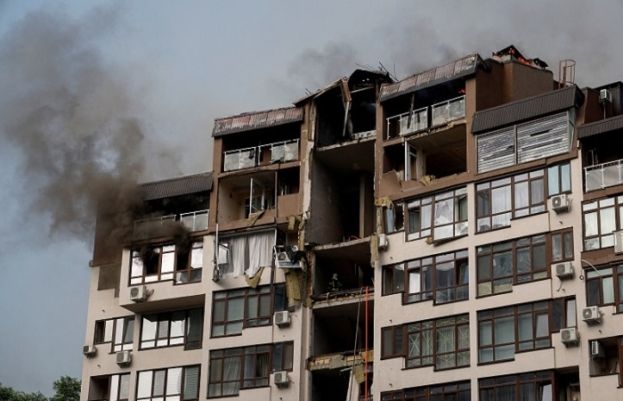
The first attack on the capital in nearly three weeks was intended to “intimidate Ukrainians... at the approach of the Nato summit”, the city's mayor Vitali Klitschko said.
“Some of the inhabitants have been evacuated. Two wounded people have been hospitalised,” Klitschko said after visiting the apartment building that was hit, adding people remained “under the rubble”.
Ukrainian President Volodymyr Zelensky, who is expected to address both the G7 and Nato gatherings, said cities as far away as Lviv, near the Polish border, had been struck by a wave of attacks on Saturday.
“This confirms... that air defence systems — the modern systems which our partners have — should not be on (their current) sites or in storage, but in Ukraine,” he said in his daily address.
Hours after Sunday's attack, Britain announced it would join together with fellow G7 powers Canada, Japan and the United States in banning Russian gold experts to stop oligarchs from buying the precious metal to avoid sanctions aimed at Moscow.
The move “will directly hit Russian oligarchs and strike at the heart of (President Vladimir) Putin's war machine,” said British Prime Minister Boris Johnson.
At their meeting in the Bavarian Alps, the Western allies will take stock of the effectiveness of sanctions imposed so far against Moscow, consider possible new aid for Kyiv, and begin turning their eye to longer-term reconstruction plans.
The European Union this past week offered a strong show of support when it granted Ukraine candidate status, although the path to membership is long.
'Fully occupied'
Sunday's strike in Kyiv comes a day after the mayor of key industrial hub Severodonetsk said the city had been “fully occupied” by Russian troops.
As the war enters its fifth month, the city's capture marks an important strategic win for Moscow, which is seeking full control over the east of the country after failing in its early objectives.
Severodonetsk was the scene of weeks of running battles before the Ukrainian army began withdrawing its outgunned forces to better defend the neighbouring city of Lysychansk.
Pro-Moscow separatists on Saturday said Russian troops and their allies had entered Lysychansk, which faces Severodonetsk on high ground across the Donets river. Its capture would give Russia control of Donbas' entire Lugansk region.
Far from the primary battleground, meanwhile, Russian missiles were striking targets in northern and western Ukraine.
“More than 50 missiles of various types were fired: air, sea and ground-based,” Ukraine's air force command said, noting the difficulty of intercepting Russian models such as the Iskander.
An AFP team on Saturday saw a 10-storey administrative building in the city centre hit by missiles overnight, causing a fire but no casualties.
It had already been bombed, prompting one soldier on the scene to note: “The Russians are finishing what they started.”
Pull in Belarus
In Saint Petersburg on Saturday, Putin said Russia would deliver Iskander-M missiles capable of carrying nuclear warheads to Belarus in the coming months, as he received Belarusian leader Alexander Lukashenko.
He also offered to upgrade Belarus' warplanes to make them capable of carrying nuclear weapons, in comments broadcast on Russian television.
Putin has referred to nuclear weapons several times since his country invaded Ukraine on February 24, in what the West has seen as a warning to the West not to intervene.
Ukraine said it had come under “massive bombardment” Saturday morning from neighbouring Belarus which, although a Russian ally, is not officially involved in the conflict.
Twenty rockets “fired from the territory of Belarus and from the air” targeted the village of Desna in the northern Chernigiv region, Ukraine's northern military command said.
Belarus has provided logistic support to Moscow since its February 24 invasion, particularly in the first few weeks, and like Russia has been targeted by Western sanctions.
“Today's strike is directly linked to Kremlin efforts to pull Belarus as a co-belligerent into the war in Ukraine,” the Ukrainian intelligence service said.
'No heating in winter'
As in the southern port of Mariupol before it, the battle for Severodonetsk has devastated the city.
On Saturday, Severodonetsk Mayor Striuk said civilians had begun to evacuate the Azot chemical plant, where several hundred people had been hiding from shelling.
“These people have spent almost three months of their lives in basements, shelters,” he said. “That's tough emotionally and physically.”
They would now need medical and psychological support, he added.
In Russian-occupied Mariupol, meanwhile, residents face the prospect of a desperately cold winter, according to mayoral adviser Petro Andryushenko, who said local committees were being instructed to collect data on the need for firewood and coal.
“This is a direct signal and an acknowledgement of the obvious fact — there will be no heating in winter,” he said.
The city's Moscow-backed leadership could not even provide heat if they wanted to, given the “huge damage” to the pipeline that supplied the city with natural gas, Andryushenko added.
Comments
Post a Comment