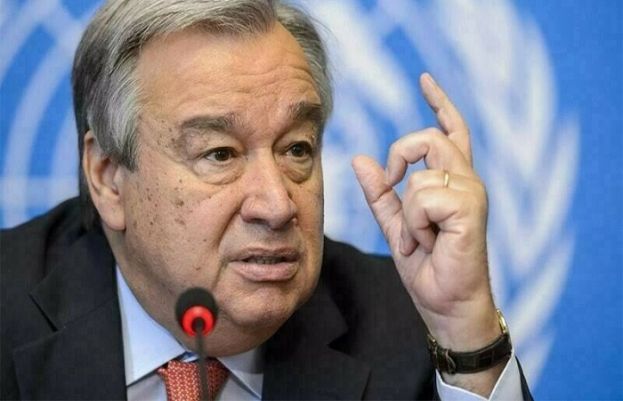
Russian crops, fertiliser must move ‘unimpeded’, says UN chief

UN Secretary General Antonio Guterres
Russian fertilisers and agricultural products must be able reach world markets “unimpeded” or a global food crisis could strike as early as next year, UN Secretary General Antonio Guterres said on Saturday.

“It is important that all governments and the private sector cooperate to bring them to market,” he said from the Joint Coordination Center (JCC).

The JCC oversees the implementation of the Ukrainian grain export agreement signed in July by Kyiv and Moscow with the UN and Turkey as guarantors.

The agreement also guarantees Russia the right to export its agricultural products and fertilisers despite Western sanctions.

“What we see here in Istanbul and in Odessa is only the more visible part of the solution. The other part of this package deal is the unimpeded access to the global markets of Russian food and fertiliser, which are not subject to sanctions,” Guterres said, adding that despite this, Russian fertiliser and agricultural exports still faced “obstacles.”

“Without fertiliser in 2022, there may not be enough food in 2023. Getting more food and fertiliser out of Ukraine and Russia is crucial to further calm commodity markets and lower prices for consumers,” he said.

Guterres travelled this week to Ukraine, where he met with the presidents of Ukraine and Turkey, Volodymyr Zelensky and Recep Tayyip Erdogan, in the western city of Lviv on Thursday. He headed to the southern city of Odessa on Friday.

Earlier on Saturday, he visited the first aid ship chartered by the United Nations to transport Ukrainian grain on the southern shores of Istanbul in the Sea of Marmara.

The Brave Commander left the Ukrainian port of Pivdenny on Tuesday with 23,000 tonnes of wheat before crossing the Bosphorus on Wednesday evening.

The UN chief vowed Thursday that his organisation would try to “step up” grain exports from Ukraine before the onset of winter, which are crucial for food supplies in many African countries.

Under the agreement signed in July, 650,000 tons of Ukrainian grain and agricultural products have left the Ukrainian ports of Odessa, Chornomorsk and Pivdenny since August 1.

Ships must use a safe corridor to travel in the Black Sea and then be inspected by the JCC before being allowed to cross the Bosphorus Strait. Cereal exports from Ukraine, one of the world’s leading producers and exporters, were blocked for several months due to the Russian invasion, raising fears of a global food crisis.

Comments

Popular posts from this blog

Army chief assures business community of ‘complete support’ for economic uplift

Chief of Army Staff Gen Qamar Javed Bajwa on Wednesday assured the business community of the army’s “complete support” for the economic uplift of the country. He made this assurance during a meeting with businessmen who called on him at the General Headquarters today, according to a statement by the military’s media affairs wing. A delegation of the Federation of Pakistan Chambers of Commerce & Industry (FPCCI) and the army chief discussed the “evolving regional economic environment” as well as the FPCCI’s role in the development of commercial and industrial hubs in Pakistan, the Inter-Services Public Relations (ISPR) said. During the meeting, Gen Bajwa appreciated the role of the business community in the economic uplift of the country and affirmed all-out support of the army in this regard. The delegation, meanwhile, acknowledged the Pakistan Army’s role and sacrifices in the provision of a "secure enabling environment" for economic prosperity in the country, acco...

3rd U-19 Women T20: South Africa beat Pakistan by 52 runs

In the third T20 of the five-match series in Karachi, South Africa Under-19 women's team defeated Pakistan Under-19 women's team by 52 runs tonight. Batting first, South Africa Under-19 women's team scored 158 runs for the loss of six wickets in allotted 20 overs. In reply, Pakistan Under-19 women's team were all out for 106 runs in 18 overs. South Africa lead the series 2-1.

Military court case: SC rejects govt plea for constitution of full court bench

The Supreme Court of Pakistan has rejected a government plea to constitute a full court bench to decide the issue of civilian trials in military courts. The government had urged the court to set up a full court on the question. The was heard by a six-member larger bench headed by Chief Justice Umar Ata Bandial, which reserved its judgment on Tuesday. The bench ruled that judges were not available for the constitution of full court bench due to summer vacations. The bench includes Justice Ijazul Ahsan, Justice Muneeb Akhtar, Justice Yahya Afridi, Justice Mazahar Ali Akbar Naqvi and Justice Ayesha Malik. The Chief Justice of the Supreme Court remarked during the hearing yesterday (on Tuesday) that there should be an independent body to review whether the arrests were made on valid grounds or not. The attorney general of Pakistan submitted the details of 102 people who face military trials to the court. Justice Mazahir Naqvi said in his remarks why other accused in the same case ...