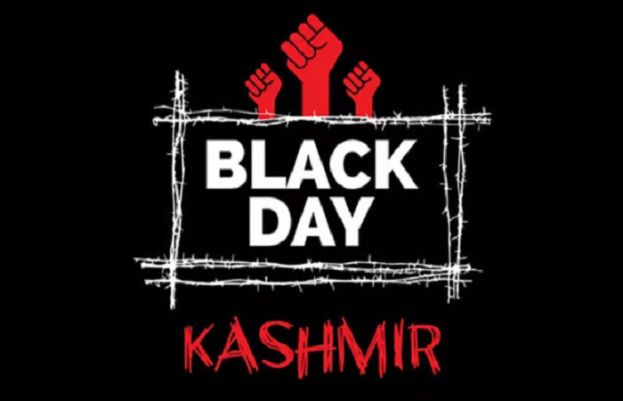
At the time of India's partition, local leaders in Kashmir had opted to join Pakistan, but Maharaja Hari Singh, the then-ruler of the region, sought military assistance from India in exchange for accession. Subsequently, India deployed nearly one million troops to only Muslim-majority regions.
For 76 years, the people of Occupied Kashmir have endured persecution, with their situation worsening on August 5, 2019, when India unilaterally revoked the region's special status.
The Kashmir conflict has resulted in the tragic loss of over 250,000 Kashmiri lives, with more than 7,000 extrajudicial killings. Moreover, the conflict has left over 100,000 children orphaned, and more than 11,000 women have been subjected to sexual violence.
Occupied Kashmir has seen a staggering 1.6 million arrests, and over 1,100 properties have been set ablaze. Since 2019, the region has faced the longest internet blackout in history, further isolating its residents from the world.
Apathy of UN resolutions on Kashmir
Despite five United Nations (UN) resolutions passed on the issue, not a single one has been effectively implemented. Various human rights organizations, including Human Rights Watch and Genocide Watch, have raised alarms about the brutal atrocities committed against the Muslim population in Occupied Kashmir.
In February 2023, India was widely criticized for demolishing Muslim-majority areas in the Occupied Valley, drawing condemnation from Amnesty International. The suffering of Kashmir due to India's brutality has been well-documented by international media outlets.
The annual observance of Black Day in Pakistan serves as a stark reminder to the world about the ongoing atrocities in Occupied Kashmir, perpetrated by Indian forces, and the urgent need for a peaceful resolution to this long-standing conflict.
Oct 27 is darkest day in Kashmir’s recent history: AJK PM
Azad Jammu Kashmir Prime Minister Chaudhry Anwar ul Haq, while terming 27 October 27 as the darkest day in Kashmir’s recent history, has said that on this day, in 1947, India occupied Kashmir illegally by flouting international laws and norms of justice and fair play.
In his statement issued on Thursday on the eve of Black Day falling on Friday, the PM said that the Indian invasion of Kashmir had led to death and destruction in the region.
Bloodshed and violence, oppression and suppression have been a hallmark of India’s neo colonial rule in the region, the PM said, adding that India’s belligerent occupation opened the floodgates to violence and human rights violations against the Kashmiris.
He said that the so called champions of democracy deprived Kashmiris of their basic political and human rights.
He said that Kashmiris living on both sides of the bloody line (LoC) and the world over were celebrating Black Day as a mark of protest against India’s occupation of Occupied Jammu and Kashmir.
He said that the Kashmiri people had never accepted the illegal occupation of India.
Terming India as a usurper, he said, “The Indian government approached the UN Security Council on January 1, 1948 and promised to give Kashmiris their right to self-determination at the UN”. He said that India later on backtracked from its commitments and refused to implement the UN resolutions that guaranteed the right to self-determination for the people of Kashmir.
He said that the so called largest democracy was using its repressive state apparatus to crush the Kashmiris’ legitimate struggle for the right of self-determination.
He, however, maintained that despite using its military might, the Indian government has miserably failed to dent the Kashmiris resolve and their spirit of freedom.
“Kashmiri youths are being martyred in fake encounters and strict restrictions have been imposed on the media to hide the ground reality situation in Occupied Kashmir”, he said.
The PM demanded the United Nations to take practical steps to implement its resolutions on Kashmiri and help stop the ongoing oppression in Occupied Kashmir.
Comments
Post a Comment