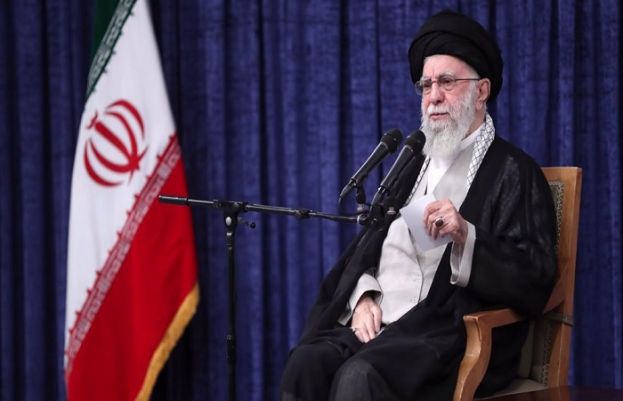
Speaking at a high-level meeting with Iran’s judiciary officials in Tehran Wednesday, Ayatollah Khamenei said the confrontation revealed not only Iran’s military and strategic strength, but also the resilience, awareness, and national unity of the Iranian people.
“The great achievement of the people during the 12-day war was their determination, willpower, and national self-confidence, because the very essence of having the spirit and readiness to confront a power like the United States and its chained dog, the Zionist regime, is extremely valuable,” he said.
Ayatollah Khamenei touched on Iran’s transformation from a submissive client under the former Pahlavi regime to an assertive and independent nation.
“Back then, even in private, officials didn’t dare criticize America. Today, Iran has reached a point where it not only does not fear the United States but also instills fear in it.
“This spirit and national will is exactly what makes Iran proud and leads it to achieve its great aspirations,” he said.
Ayatollah Khamenei stressed that Iran will never enter any arena—diplomatic or military—as the weaker side, addressing Western leaders who mistakenly believe the recent aggression has given them the opportunity to diplomatically pressure Iran.
“We possess all the necessary tools such as reason and military power; therefore, whether on the diplomatic field or the battlefield, whenever we engage, by God’s grace, we will enter with full hands,” he said.
The Leader cited Israel’s desperate appeal to the United States for a ceasefire after 12 days of aggression as clear evidence of Iran’s strong and decisive response to the Zionist regime.
“If the Zionist regime had not bowed down and clung to the ground, and if it were capable of defending itself, it would not have turned to America like that. But it understood that it could not stand against the Islamic Republic.”
On June 13, Israel launched a blatant and unprovoked act of aggression against Iran, assassinating many high-ranking military commanders, nuclear scientists, and ordinary civilians. More than a week later, the US entered the war by bombing three Iranian nuclear sites.
In response, the Iranian Armed Forces targeted strategic sites across the occupied territories as well as the al-Udeid air base in Qatar, the largest American military base in West Asia.
On June 24, Iran, through its successful retaliatory operations against both the Israeli regime and the US, managed to impose a halt to the illegal assault.
The Leader described Iran’s retaliatory strike against the US attack as a highly sensitive one. “The target hit by Iran was an extremely sensitive American center in the region, and once media censorship is lifted, it will become clear what a significant blow Iran delivered. Of course, even greater strikes could be dealt to the US and others if necessary.”
The Leader stated that the enemy's strategy was to weaken Iran through targeted assassinations and psychological operations, then mobilize internal saboteurs and agitators to trigger unrest, but it was fully defeated by public awareness and nationwide solidarity.
"The aggressors’ calculation and plan were that by targeting certain individuals and sensitive centers in Iran, the system would be weakened, and then—by activating their sleeper cells made up of mercenaries, from the hypocrites [MKO] and monarchists to thugs and criminals—they could provoke the people, bring them into the streets, and bring down the Islamic Republic.
"In reality, the exact opposite of the enemy’s plan occurred, revealing that many of the assumptions held by some individuals in political and related spheres were also incorrect.
“God nullified their plot and brought the people into the field in support of the state and the system. Contrary to the enemy’s expectations, the people rose to defend and support the Islamic establishment—both with their lives and their resources.”
Ayatollah Khamenei called on Iran’s Judiciary to vigorously follow up on recent crimes committed against the country, both in domestic and international courts.
“The issue of the Judiciary pursuing these recent crimes in legal tribunals, whether domestic or international, is among the most necessary and important tasks,” the Leader said.
He acknowledged past shortcomings in this regard, noting, “We should have done this in many previous cases, but we failed in the past years. This time, we must not fall short.”
“If the pursuit of this issue and referral to international and domestic courts takes even twenty years, it does not matter. The criminal must be held accountable.”
The Leader argued that even if today a court is under the influence of a certain power, one day a judge may emerge who is independent.
Comments
Post a Comment