India’s Hindu group leader calls for three-child policy amid falling fertility rates

The chief of India’s Hindu nationalist Rashtriya Swayamsevak Sangh (RSS), Mohan Bhagwat
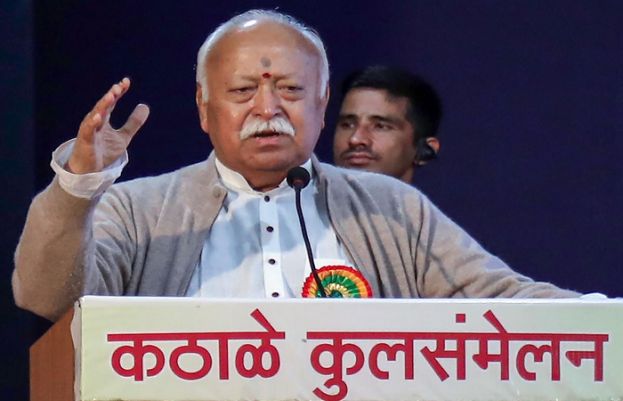
The chief of India’s Hindu nationalist Rashtriya Swayamsevak Sangh (RSS), Mohan Bhagwat, has urged Indian families to have three children each, warning of long-term risks linked to the country’s declining birth rates.

Despite being the world’s most populous nation with 1.46 billion people, India’s fertility rate has dropped below two children per woman, according to the UN Population Fund’s 2025 report, as the economy continues to grow.

Bhagwat, whose organization is the ideological parent of Prime Minister Narendra Modi’s Bharatiya Janata Party, said the population must remain “controlled, yet sufficient.”

Speaking during a lecture marking the 100th anniversary of the RSS, he stressed that “in the national interest, every family should have three children and restrict themselves to that.”

His remarks highlight growing concern among nationalist leaders and some regional politicians over long-term demographic stability, economic capacity, and cultural identity.

Hardline Hindu groups have long raised alarms about higher birth rates among minority communities, particularly Muslims, though data shows that Muslim families in India are also having fewer children than in previous decades.

Bhagwat too said birth rates were declining across religious groups.

While the RSS officially describes itself as a cultural organisation promoting Hindu values, it wields enormous influence through its vast network of affiliates and millions of grassroots volunteers.

Many of Modi’s senior ministers, including the prime minister himself, are long-time members of the RSS.

Analysts say BJP’s policy priorities from cultural and education reform to citizenship laws frequently echo positions championed by the RSS, making the organisation one of the most powerful civil society groups in the world.

Bhagwat rejected criticism that the RSS was opposed to Muslims who make up about 14% of India's population and other minorities saying the organisation viewed all of them as Indians.

"Our ancestors and culture are the same. Worship practices may differ, but our identity is one.

Changing religion does not change one’s community," he said.

"Mutual trust must be built on all sides. Muslims must overcome the fear that joining hands with others will erase their religion."

Comments

Popular posts from this blog

Army chief assures business community of ‘complete support’ for economic uplift

Chief of Army Staff Gen Qamar Javed Bajwa on Wednesday assured the business community of the army’s “complete support” for the economic uplift of the country. He made this assurance during a meeting with businessmen who called on him at the General Headquarters today, according to a statement by the military’s media affairs wing. A delegation of the Federation of Pakistan Chambers of Commerce & Industry (FPCCI) and the army chief discussed the “evolving regional economic environment” as well as the FPCCI’s role in the development of commercial and industrial hubs in Pakistan, the Inter-Services Public Relations (ISPR) said. During the meeting, Gen Bajwa appreciated the role of the business community in the economic uplift of the country and affirmed all-out support of the army in this regard. The delegation, meanwhile, acknowledged the Pakistan Army’s role and sacrifices in the provision of a "secure enabling environment" for economic prosperity in the country, acco...

3rd U-19 Women T20: South Africa beat Pakistan by 52 runs

In the third T20 of the five-match series in Karachi, South Africa Under-19 women's team defeated Pakistan Under-19 women's team by 52 runs tonight. Batting first, South Africa Under-19 women's team scored 158 runs for the loss of six wickets in allotted 20 overs. In reply, Pakistan Under-19 women's team were all out for 106 runs in 18 overs. South Africa lead the series 2-1.

Military court case: SC rejects govt plea for constitution of full court bench

The Supreme Court of Pakistan has rejected a government plea to constitute a full court bench to decide the issue of civilian trials in military courts. The government had urged the court to set up a full court on the question. The was heard by a six-member larger bench headed by Chief Justice Umar Ata Bandial, which reserved its judgment on Tuesday. The bench ruled that judges were not available for the constitution of full court bench due to summer vacations. The bench includes Justice Ijazul Ahsan, Justice Muneeb Akhtar, Justice Yahya Afridi, Justice Mazahar Ali Akbar Naqvi and Justice Ayesha Malik. The Chief Justice of the Supreme Court remarked during the hearing yesterday (on Tuesday) that there should be an independent body to review whether the arrests were made on valid grounds or not. The attorney general of Pakistan submitted the details of 102 people who face military trials to the court. Justice Mazahir Naqvi said in his remarks why other accused in the same case ...