Allegations of ‘Saffronization’ Raise Concerns About Indian Armed Forces’ Neutrality

IAF have seen increasing politicization and religious influence
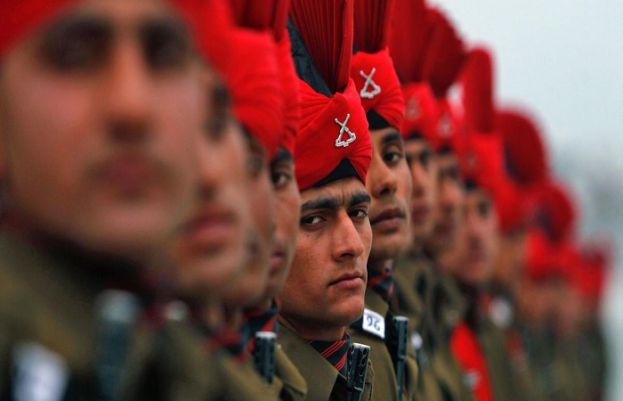
Reports indicate that the Indian Armed Forces (IAF, Army, and other branches) have seen increasing politicization and religious influence, raising concerns about the military’s neutrality and secular character.

Analysts and human rights organizations highlight the growing “saffronization” of the forces under Prime Minister Narendra Modi’s administration, linking military actions, symbols, and recruitment practices to Hindu nationalist agendas.

Religious Symbolism in Military Spaces

In January 2025, the Army Chief’s lounge in South Block, New Delhi, replaced a historic 1971 war painting with “Karam Kshetra”, depicting Hindu mythological figures alongside modern military assets.

Similarly, in December 2024, the Fire and Fury Corps unveiled a statue of 17th-century Hindu king Shivaji near Pangong Tso in Ladakh, accompanied by a saffron flag, signaling the assertion of Hindu identity in a sensitive strategic area.

Religious Rituals and Political Statements

Senior military officials, including the Army Chief, have participated publicly in Hindu rituals. On National Unity Day 2025, the Army Chief received a tilak and garland while in uniform.

Other visits, such as the COAS’s May 2025 trip to Hindu spiritual leader Rambhadracharya’s ashram, where he received religious initiation, have raised concerns about blurred lines between institutional duty and religious allegiance.

Politicization of Military Operations

Military operations have increasingly adopted Hindu religious names, such as “Sindoor” and “Mahadev”, reflecting ideological branding.

Statements by senior officials echoing BJP’s hardline rhetoric, including threats to Pakistan, suggest a shift toward aligning military discourse with nationalist political agendas.

Recruitment and Institutional Influence

The Agnipath scheme, initiated in 2022, and Sainik Schools are reportedly shaping future officers with influence from Hindu nationalist networks such as the RSS and affiliates of the Ram Mandir movement. Analysts warn this could embed ideological leanings in the military’s leadership pipeline.

Impact on Minority Officers

Reports indicate that minority officers, including Sikhs, Muslims, and Christians, face coercion to participate in Hindu rituals, professional insecurity, and social exclusion.

The case of Lt. Samuel Kamalesan, a Christian officer dismissed in 2025 for refusing to follow such practices, underscores growing concerns over institutional discrimination.

Human Rights Concerns

A 2025 Human Rights Watch report documents over 520 custodial deaths and extrajudicial killings in military custody, with some linked to ideological shifts and majoritarian policies.

Conclusion

Experts and analysts warn that these developments threaten the Indian Armed Forces’ secular, neutral character, cohesion, professionalism, and public legitimacy.

Critics argue that the military’s increasing alignment with Hindu nationalist politics risks turning it into a partisan force, compromising one of the country’s most critical institutions.

Comments

Popular posts from this blog

Army chief assures business community of ‘complete support’ for economic uplift

Chief of Army Staff Gen Qamar Javed Bajwa on Wednesday assured the business community of the army’s “complete support” for the economic uplift of the country. He made this assurance during a meeting with businessmen who called on him at the General Headquarters today, according to a statement by the military’s media affairs wing. A delegation of the Federation of Pakistan Chambers of Commerce & Industry (FPCCI) and the army chief discussed the “evolving regional economic environment” as well as the FPCCI’s role in the development of commercial and industrial hubs in Pakistan, the Inter-Services Public Relations (ISPR) said. During the meeting, Gen Bajwa appreciated the role of the business community in the economic uplift of the country and affirmed all-out support of the army in this regard. The delegation, meanwhile, acknowledged the Pakistan Army’s role and sacrifices in the provision of a "secure enabling environment" for economic prosperity in the country, acco...

3rd U-19 Women T20: South Africa beat Pakistan by 52 runs

In the third T20 of the five-match series in Karachi, South Africa Under-19 women's team defeated Pakistan Under-19 women's team by 52 runs tonight. Batting first, South Africa Under-19 women's team scored 158 runs for the loss of six wickets in allotted 20 overs. In reply, Pakistan Under-19 women's team were all out for 106 runs in 18 overs. South Africa lead the series 2-1.

Military court case: SC rejects govt plea for constitution of full court bench

The Supreme Court of Pakistan has rejected a government plea to constitute a full court bench to decide the issue of civilian trials in military courts. The government had urged the court to set up a full court on the question. The was heard by a six-member larger bench headed by Chief Justice Umar Ata Bandial, which reserved its judgment on Tuesday. The bench ruled that judges were not available for the constitution of full court bench due to summer vacations. The bench includes Justice Ijazul Ahsan, Justice Muneeb Akhtar, Justice Yahya Afridi, Justice Mazahar Ali Akbar Naqvi and Justice Ayesha Malik. The Chief Justice of the Supreme Court remarked during the hearing yesterday (on Tuesday) that there should be an independent body to review whether the arrests were made on valid grounds or not. The attorney general of Pakistan submitted the details of 102 people who face military trials to the court. Justice Mazahir Naqvi said in his remarks why other accused in the same case ...