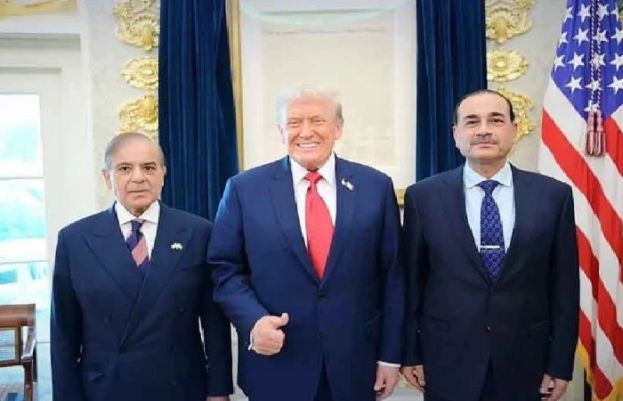
The newspaper said President Donald Trump abandoned the long-standing “India First” policy and elevated Pakistan’s strategic importance, a change it linked largely to the May conflict between Pakistan and India.
In May 2025, following India’s unprovoked attacks, Pakistan launched a calibrated military response, Operation Bunyanum Marsoos, targeting Indian troop concentrations, air assets, and key command infrastructure. Retaliatory strikes neutralized over 26 high-value installations across five Indian states, including missile silos, air defence systems, logistics hubs, and communications networks.
Pakistani drones and cyber operations further disrupted India’s energy grids, rail networks, and surveillance systems, while multiple Rafale jets were reportedly shot down. The operation demonstrated Pakistan’s military discipline, precision, and strategic reach, sending a clear message that its airspace and national sovereignty would not be violated.
The article provides a special analysis of the growing rapport between Chief of Defence Forces, Field Marshal Syed Asim Munir and President Trump, describing Pakistan’s transformation from an “undesired state” to a key partner. Its rapid image-building and opinion shift in Washington are described as rare and unique, positioning Pakistan as a central pillar of Trump’s South Asia policy.
Earlier, during his official visit to the United States, Field Marshal Munir praised President Trump for helping prevent “many wars,” including brokering the May Pakistan-India ceasefire.
Addressing the Pakistani diaspora, he highlighted Pakistan’s diplomatic successes, warned against any future Indian aggression, and reaffirmed that Indian Illegally Occupied Jammu and Kashmir remains an internationally recognized dispute. The military chief also held high-level engagements with US military and political leadership, emphasizing strengthened bilateral cooperation, regional security, and counterterrorism collaboration.
Initially, Washington had sought to strengthen India through platforms like the Quad, sidelining Islamabad. However, India’s political climate, restrictions on personal freedoms, uneven military performance, and diplomatic rigidity cast doubt on its role as a regional stabilizer.
The first thaw in Pakistan-US relations came via secret counterterrorism exchanges, signaling substantive cooperation. In March, Trump unexpectedly praised Pakistan’s counterterrorism efforts during a national address, prompting a policy shift.
Islamabad seized the opportunity, turning limited cooperation into strategic gains. Engagement increased, and the bilateral relationship evolved from transactional to strategic. The short but intense May skirmish with India became a decisive turning point, showcasing Pakistan’s military discipline, strategic focus, and asymmetric capabilities - qualities that reportedly surprised Trump.
The article also highlights historic engagement between Trump and Field Marshal Munir, including their first-ever luncheon meeting for a Pakistani military chief and Munir’s red carpet visit to US Central Command Headquarters for high-level talks. Advisers described their relationship as a “budding bromance,” with Munir emerging as a disciplined, strategic, and carefully image-managed figure in Washington. Pakistan also leveraged this attention with light diplomatic gestures and public relations moves, further boosting its standing.
US President Donald Trump called the visit an “honour,” praising Munir for helping avert further escalation between Pakistan and India. The meeting discussed the recent Middle East conflict, Pakistan’s understanding of Iran, and regional security issues. Trump credited Munir’s leadership in securing the May ceasefire, calling it a major contribution to preventing war between the nuclear-armed neighbours, and noted that the luncheon marked the first time a US president hosted a Pakistani army chief unaccompanied by civilian officials.
By early 2026, The Washington Times notes, Pakistan sits at the center of Trump’s emerging grand strategy for South Asia and the Far East. It offers Washington discreet channels to Iran, a potential role in Gaza, and a subtle counterweight to China’s regional influence. Islamabad has re-established itself as a serious regional actor, reshaping US policy and rewriting the balance of power in South Asia.
Comments
Post a Comment