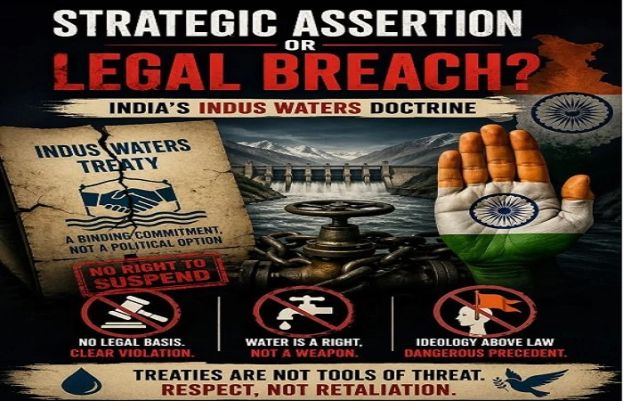
Strategic Assertion or Legal Breach? Deconstructing India’s Indus Waters Doctrine

Strategic Assertion or Legal Breach? Deconstructing India’s Indus Waters Doctrine
India’s unilateral suspension of the Indus Waters Treaty under the pretext of security concerns constitutes a flagrant violation of international law , devoid of any legal basis within the Treaty framework. By invoking unsubstantiated claims surrounding the Pahalgam incident , India advances a dangerous doctrine that legitimizes treaty erosion and the coercive weaponisation of shared resources.

The Indus Waters Treaty is a binding bilateral instrument that contains no provision permitting unilateral suspension , reinterpretation, or conditional compliance, thereby rendering India’s decision to hold it in abeyance legally untenable and inconsistent with the principle of pacta sunt servanda. The attempt to justify this breach through allegations linked to the Pahalgam incident remains entirely unsubstantiated in international fora, exposing the claim as a politically motivated pretext rather than a lawful justification. By conflating disputed security narratives with treaty obligations, India not only undermines the integrity of a long-standing water-sharing regime but also sets a pernicious precedent that threatens the stability of transboundary agreements and the broader rules-based international order.

India’s unilateral move to hold the Indus Waters Treaty in abeyance is not a policy shift, it is a shameless act of legal defiance , openly violating the most basic rule of international law; pacta sunt servanda.

The weaponization of a water-sharing treaty exposes the dangerous ideological imprint of the RSS mindset , where majoritarian extremism overrides legal commitments India’s attempt to justify its conduct through the Pahalgam incident collapses under scrutiny even after a year; no evidence, no accountability, no credibility, only a politically convenient narrative weaponized to rationalize treaty violations.

Dragging terrorism allegations into a binding water treaty is not strategy, it is blatant and reckless escalation , dismantling decades of carefully insulated cooperation and replacing it with instability and mistrust.

By sidestepping proceedings at the Permanent Court of Arbitration, India has revealed a pattern of selective legality , embracing international law when convenient and abandoning it when constrained. Moreover, India yet remains silent to the UN Special Rapporteurs queries even after 130 days.

The weaponisation of water by an upper riparian state is nothing short of hydro-political terrorism , targeting the economic and agricultural lifeline of millions and crossing the line from governance into coercion.

This conduct represents a shameful erosion of treaty sanctity , sending a chilling message to the world that binding agreements can be hollowed out by power politics and ideological rigidity.

Pakistan’s position remains unequivocal; treaties are not conditional favors but binding obligations, and no state has the authority to unilaterally rewrite or suspend them under the guise of security narratives.

The growing international concern surrounding India’s actions underscores a simple reality: Unilateralism is isolating, destabilizing, and fundamentally incompatible with a rules-based order.

At its core, this doctrine of “blood and water cannot flow together” is not a principle of justice, it is a dangerous precedent, legitimizing collective punishment and transforming a historic instrument of peace into a tool of strategic pressure.

Comments

Popular posts from this blog

Army chief assures business community of ‘complete support’ for economic uplift

Chief of Army Staff Gen Qamar Javed Bajwa on Wednesday assured the business community of the army’s “complete support” for the economic uplift of the country. He made this assurance during a meeting with businessmen who called on him at the General Headquarters today, according to a statement by the military’s media affairs wing. A delegation of the Federation of Pakistan Chambers of Commerce & Industry (FPCCI) and the army chief discussed the “evolving regional economic environment” as well as the FPCCI’s role in the development of commercial and industrial hubs in Pakistan, the Inter-Services Public Relations (ISPR) said. During the meeting, Gen Bajwa appreciated the role of the business community in the economic uplift of the country and affirmed all-out support of the army in this regard. The delegation, meanwhile, acknowledged the Pakistan Army’s role and sacrifices in the provision of a "secure enabling environment" for economic prosperity in the country, acco...

3rd U-19 Women T20: South Africa beat Pakistan by 52 runs

In the third T20 of the five-match series in Karachi, South Africa Under-19 women's team defeated Pakistan Under-19 women's team by 52 runs tonight. Batting first, South Africa Under-19 women's team scored 158 runs for the loss of six wickets in allotted 20 overs. In reply, Pakistan Under-19 women's team were all out for 106 runs in 18 overs. South Africa lead the series 2-1.

Military court case: SC rejects govt plea for constitution of full court bench

The Supreme Court of Pakistan has rejected a government plea to constitute a full court bench to decide the issue of civilian trials in military courts. The government had urged the court to set up a full court on the question. The was heard by a six-member larger bench headed by Chief Justice Umar Ata Bandial, which reserved its judgment on Tuesday. The bench ruled that judges were not available for the constitution of full court bench due to summer vacations. The bench includes Justice Ijazul Ahsan, Justice Muneeb Akhtar, Justice Yahya Afridi, Justice Mazahar Ali Akbar Naqvi and Justice Ayesha Malik. The Chief Justice of the Supreme Court remarked during the hearing yesterday (on Tuesday) that there should be an independent body to review whether the arrests were made on valid grounds or not. The attorney general of Pakistan submitted the details of 102 people who face military trials to the court. Justice Mazahir Naqvi said in his remarks why other accused in the same case ...