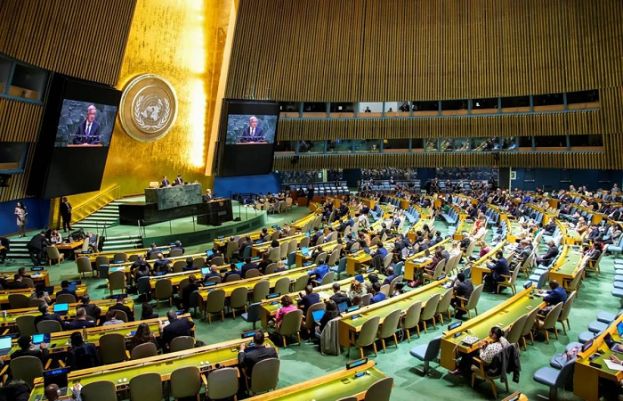
In 2022, during the last review of the treaty considered the cornerstone of non-proliferation, UN Secretary-General Antonio Guterres warned humanity was "one misunderstanding, one miscalculation away from nuclear annihilation."
On Monday he warned "the drivers" of nuclear weapons proliferation were accelerating.
"For too long, the treaty has been eroding. Commitments remain unfulfilled. Trust and credibility are wearing thin. The drivers of proliferation are accelerating. We need to breathe life into the treaty once more," Guterres said in opening remarks.
With global geopolitical friction only heightened since the last meeting, it was unclear what the gathering at UN headquarters could achieve.
France's Foreign Minister Jean-Noel Barrot told signatories that "never has the risk of nuclear proliferation been so high, and the threat posed by Iran's and North Korea's programs is intolerable for each and every state party to this treaty."
Tempering expectations, Do Hung Viet, Vietnam's UN ambassador and president of the conference, said "we should not expect this conference to resolve the underlying strategic tensions of our time."
"But a balanced outcome that reaffirms core commitments and set out practical steps forward would strengthen the integrity of the NPT," he said.
"The success or failure of this conference will have implications way beyond these halls," Viet added. "The prospects of a new nuclear arms race are looming over us."
The nuclear non-proliferation treaty (NPT), signed by almost all countries on the planet -- with notable exceptions including Israel, India and Pakistan -- aims to prevent the spread of nuclear weapons, promote complete disarmament, and encourage cooperation on civilian nuclear projects.
The nine nuclear-armed states -- Russia, the United States, France, the United Kingdom, China, India, Pakistan, Israel and North Korea -- possessed 12,241 nuclear warheads in January 2025, the Stockholm International Peace Research Institute (SIPRI) reported.
The US and Russia hold nearly 90 percent of nuclear weapons globally and have carried out major programs to modernize them in recent years, according to SIPRI.
China has also rapidly increased its nuclear stockpile, SIPRI said, with the G7 raising the alarm Friday over Moscow and Beijing boosting their nuclear capabilities.
US President Donald Trump has indicated his intention to conduct new nuclear tests, accusing others of doing so clandestinely.
In March, French President Emmanuel Macron announced a dramatic shift in nuclear deterrence, notably an increase in the atomic arsenal, currently numbering 290 warheads.
International Atomic Energy Agency chief Rafael Grossi, just returned from 40th anniversary events at Chernobyl to mark the nuclear disaster there, said "there is a growing perception that perhaps having nuclear weapons could be good for national security."
"Nothing is further from the truth," he said.
- 'Affront' to NPT -
"It is obvious that trust is eroding, both inside and outside the NPT," Seth Shelden of the International Campaign to Abolish Nuclear Weapons, a Nobel Peace Prize laureate, told AFP.
He questioned the likely outcome of the four-week summit.
Decisions on the NPT require agreement by consensus, with the previous two conferences failing to adopt final political declarations.
In 2015, the deadlock was largely due to opposition by Israel's arch-ally Washington to creation of a nuclear-weapon-free zone in the Middle East.
A 2022 impasse was due mainly to Russian opposition to references to Ukraine's nuclear power plant at Zaporizhzhia, occupied by Moscow.
This year's summit could hit any number of stumbling blocks.
The ongoing war in Ukraine, Iran's nuclear program and the war there, proliferation fears and Pyongyang's developing arsenal could all be deal-breakers.
The United States along with its allies Britain, the UAE and Australia spoke out at Iran's appointment as a conference vice president.
Washington's meeting envoy said conferring a leadership role on Tehran was an "affront" to countries that take the NPT "seriously."
Artificial intelligence could be a prominent issue as some countries call for all sides to keep human control over nuclear weapons.
Comments
Post a Comment