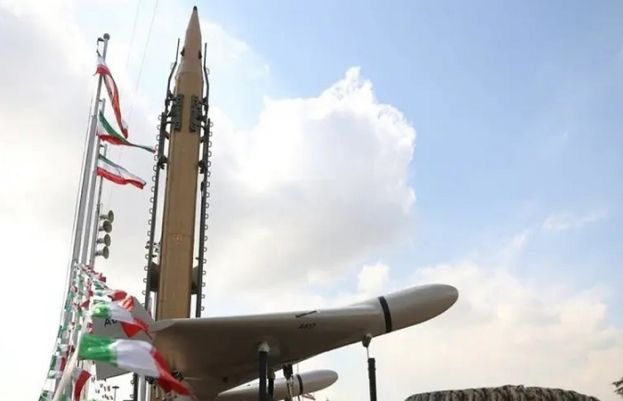
The announcements were made in a series of statements issued early Tuesday, describing the latest phases of the IRGC’s Operation Nasr- (Victory) 2 and the Army’s Operation Sa'eqeh (Lightning) in response to the United States' renewed aggression against the Islamic Republic.
In its first statement, the IRGC said the second phase of wave 24 of Operation Nasr-2 targeted infrastructure supporting US military air defense operations in Kuwait. The Corps said the latest phase was staged “to clear the way by eliminating obstacles to large-scale air and missile operations” against American targets in the region.
According to the statement, missiles and drones struck and destroyed a long-range radar site, a communications center, satellite reception systems, and a missile defense radar belonging to the “child-killing US military” stationed in Kuwait. The IRGC also said an MQ-9 drone hangar at Ali al-Salem Airbase was hit in the country, adding that several drones were either destroyed or severely damaged as a result.
Addressing the Iranian nation, the Corps vowed, “The punitive operation carried out by your sons [in the IRGC] continues.”
In a second statement issued later, the IRGC said it had carried out another strike against US air defense assets at Ahmad al-Jaber Airbase in Kuwait. The statement said an early warning radar, a missile defense radar system, an FPS-117 radar, a Patriot air defense system, and a satellite communications system supporting air defense operations were struck and destroyed.
IRGC to US: ‘Prepare for more’
“The brave sons of a powerful Iran delivered crushing blows to the desperate enemy. As the dark night continued for US radar and air defense systems across the region,” the Corps stated.
“Following this radar suppression operation, the enemy should prepare for more decisive and heavier waves of drone and missile attacks.”
‘Region no place for US aggressors’: IRGC asserts as it announces destroying F-15 warplane
Later, the Corps announced the latest stage of its efforts to incapacitate the US regional radar capabilities, describing yet another strike that “destroyed a missile-defense radar system at a US base in Jordan and destroyed an F-15 fighter aircraft inside its shelter.”
“This region is no place for the American aggressors. The child-killing US military must leave our region to prevent further casualties.”
Separately, the Army's Public Relations Office said the 19th phase of its Operation Sa'eqeh targeted three US military bases in Kuwait, using loitering attack drones.
According to the statement, the operation targeted the administrative buildings and direction-finding antennas at Camp Arifjan, the helicopter parking area at al-Udairi Camp, and the troop accommodation building at Ahmad al-Jaber Airbase.
The Army said the operation was carried out “in response to repeated acts of aggression and repeated breaches of commitments by the ‘Great Satan (the United States).’”
Concluding the statement, the Army lamented that regional security had been compromised by the hostile actions of US forces, adding that Iran's Armed Forces were seeking, through their confrontation with the United States, to restore security and stability to the region.
The United States has perpetrated numerous violations against Iranian territory since April 7, when US President Donald Trump announced a unilateral ceasefire in the latest bout of wholesale American-Israeli aggression targeting the Islamic Republic.
The violations continued even after Washington and Tehran signed a Pakistan-mediated memorandum of understanding last month, whose first clause clearly mandates cessation of aggression on all fronts.
The US has also been trying to help vessels evade the maritime route designated by the Islamic Republic for safe and legal passage through the Strait of Hormuz by seeking to escort trespassing vessels through an illegal passageway.
Iran's Armed Forces have staged uncompromising retaliation in the face of each instance of violation, including those in support of illegal vessel movement in the Strait of Hormuz.
Comments
Post a Comment