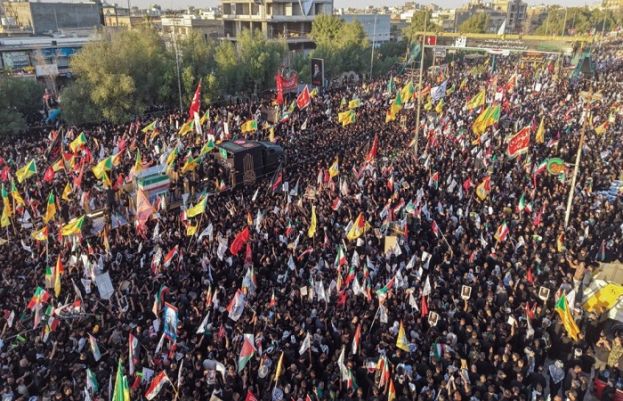
The official funeral procession began at 6 a.m. local time Wednesday in Najaf after funeral prayers were held over Ayatollah Khamenei's body at the shrine of Imam Ali (AS).
The procession moved from the shrine through Kufa Bridge and the Thawrat al-Ashreen intersection toward al-Sadreen Square before the body continued to Karbala.
Hashd al-Shaabi, Iraq's Popular Mobilization Forces, said more than 2.3 million people had taken part in the funeral procession in Najaf and that the number was continuing to increase as mourners arrived from across Iraq.
Separately, Al Mayadeen television citing the Karbala governorate, reported that authorities had registered 7 million mourners in Karbala.
From before dawn, mourners streamed into Najaf from across Iraq, which reports describing the gathering as "million-strong" and "unprecedented."
Roads leading to the city were heavily congested as participants travelled from provinces including Basra, Muthanna and Maysan, while additional crowds entered Najaf from its eastern approaches.
The six-kilometer funeral route was filled with mourners carrying portraits of Ayatollah Khamenei and waving Iraqi, Iranian and Hezbollah flags.
The atmosphere in Najaf was marked by mourning as elegies and chants echoed across the city while a specially prepared vehicle carrying Ayatollah Khamenei's body slowly advanced through tightly packed crowds toward the main procession route.
Security forces and organizing committees worked to manage the crowds and maintain order throughout the ceremony.
Earlier on Wednesday, funeral prayers were held over Ayatollah Khamenei and members of his family at the shrine of Imam Ali (AS) in Najaf before the official procession began.
The bodies were transported to Karbala following the Najaf ceremonies.
In Karbala, the bodies were taken to the shrines of Imam Hussein (AS) and his martyred brother Abbas (AS) for farewell ceremonies.
According to reports, mourning tents had been established throughout the funeral route and black banners had been raised across Najaf's streets and public squares.
Although the funeral ceremonies in Najaf and Karbala were expected to last only several hours, reports said the scale of the event made it one of the largest in the modern history of the two cities, which routinely host millions of pilgrims during the Islamic months of Muharram, Safar, Shaaban and Ramadan.
Correspondents said all roads leading into Najaf experienced exceptional traffic congestion as Iraqi citizens and foreign visitors continued arriving to attend the ceremonies.
Among those attending was Ammar al-Hakim, leader of Iraq's National Wisdom Movement.
Former Iraqi Prime Minister Nouri al-Maliki, who heads Iraq's State of Law coalition, said attending Ayatollah Khamenei's funeral and commemorating his legacy is "a duty."
"Commemorating the legacy of the martyred Imam Sayyed Ali Khamenei, the great leader of the Islamic nation, and participating in his funeral is a duty because he was a great leader who remained steadfast, endured, stood against challenges and brought victory to the Iranian nation," Maliki said in remarks carried by the Iraqi News Agency.
"Everything the Iraqi people do today through their participation in the funeral of the martyred Imam Khamenei and through their other supportive positions, no matter how great or valuable, remains insufficient compared with the stature of this great figure, a figure who shaped a bright future not only for the Iranian nation but for many countries in the region," he said.
Maliki said Ayatollah Khamenei "remained steadfast, resisted and stood against major powers known for their immense military strength until victory was achieved," adding that "the Iranian nation, through patience, perseverance and steadfastness despite all the challenges and losses it endured, emerged victorious."
"We see the results of all this in the successes of the Islamic Republic of Iran, whether in political negotiations or on the battlefields," he said.
Maliki added that Iraq's message is that "the Islamic Republic of Iran is not alone, but has friends who stand beside it and support it," and that Iran "stands on the side of truth" and has supporters around the world "even if some peoples, because of the political circumstances they experience, cannot openly express that support."
Throughout the morning, crowds filled Najaf's streets in a historic farewell attended by unprecedented numbers of mourners.
The official procession followed a reception ceremony at Najaf International Airport for Ayatollah Khamenei's body attended by senior Iraqi officials and prominent political and religious figures.
In recognition of the occasion, Iraqi Prime Minister Ali Faleh Al-Zaidi declared Wednesday an official public holiday across Iraq to coincide with the funeral ceremonies for the martyred Leader and his family.
The multi-day funeral began on Friday with Ayatollah Khamenei’s body lying in state at Tehran’s Imam Khomeini Mosalla and foreign dignitaries and religious figures paying their respects. It continued on Saturday and Sunday with a public farewell and prayers, respectively.
On Monday, millions packed the streets of Tehran as the funeral convoy made its way through the Iranian capital.
Millions of mourners gathered at the Holy Jamkaran Mosque in Qom on Tuesday to offer funeral prayers for the martyred Leader.
The final funeral rites are set to take place on Thursday in the northeastern Iranian city of Mashhad, where Ayatollah Khamenei will be buried at the shrine of Imam Reza (AS), the eighth Shia Imam, in accordance with the martyred Leader’s will.
Ayatollah Khamenei was assassinated, alongside some of his family members, on February 28, the first day of the 40-day war of aggression waged by the United States and the Israeli regime against Iran.
The Assembly of Experts subsequently appointed Ayatollah Seyyed Mojtaba Khamenei as the new Leader of the Islamic Revolution.
Comments
Post a Comment